Title deed fees in Türkiye: calculation, buyer and seller costs
For an ordinary property sale in Türkiye, title deed fees total 4% of the actual declared sale price, subject to the municipal property-tax value as a minimum. Buyer and seller each owe 2%. The separate registry service charge must also be budgeted. Underdeclaring can lead to additional fees, interest and a tax-loss penalty.
Buying or selling a home involves more than the agreed property price. Registry fees and administrative charges can be substantial, particularly for high-value properties in Kadıköy, Bağdat Avenue and the coastal neighbourhoods.
Review the title record and encumbrances before the transfer, then calculate the costs on the correct basis. The municipal property-tax value and the actual amount paid are different concepts; the lower figure is not an optional alternative to the real price.
1. Title deed fees: the ordinary 2026 rates
Direct answer: The title deed fee, or tapu harcı, is charged on the transfer and registration of property. In an ordinary sale, buyer and seller together pay 4% of the relevant base.
Under Tariff No. 4 to Fees Law No. 492, the ordinary rate is 2% for each party. A sale with a fee base of TRY 10 million therefore produces TRY 400,000 in total fees, excluding the service charge. Use the official assessment and payment reference, and keep both parties’ receipts.
Article 63 requires the actual declared transfer price, no lower than the property-tax value. If the actual price is higher, it must be declared. A qualifying transaction under urban-transformation Law No. 6306 may have an exemption; eligibility depends on the specific transfer and documents, rather than simply being a new building.
2. Who pays: buyer and seller shares
Direct answer: The buyer owes 2% and the seller owes 2%. A private agreement that one party will bear more of the cost does not change the statutory taxpayer allocation.

Sellers sometimes ask the buyer to cover the whole bill. If accepted, record the arrangement clearly in the transaction documents. This allocates the economic burden between the parties; it does not bind the tax authority to pursue only the buyer.
An underpayment assessment can concern each party’s own liability. A right of reimbursement under a private agreement is a separate question. Agree the costs in writing before completion and retain proof of what was paid on whose behalf.
3. The land registry service charge
Direct answer: Döner sermaye is a separate land-registry service charge. Its amount follows the applicable TKGM tariff and transaction characteristics, rather than the 4% calculation.
The tariff can involve a base amount, local coefficients and additional rules for particular services. A transaction involving a foreign party may fall under specific tariff provisions. Do not assume a single nationwide amount or a blanket multiplier: check the current official assessment for the actual transaction.
The buyer commonly bears this charge in practice, but the parties should confirm the allocation. Distinguish its payment notice from the title deed fee notice and complete the required payments through official channels before the registry appointment.
4. Municipal tax value versus the actual sale price
Direct answer: Municipal property-tax value is a statutory minimum for the fee base. The actual sale price is the consideration genuinely paid or payable for the transfer.
| Comparison | Actual-price declaration | Municipal value alone, where below the price |
|---|---|---|
| Legal basis | Consistent with Article 63 when accurate | Understates the actual transaction |
| Tax examination | Keep supporting evidence; no blanket immunity | Price and payment discrepancies may be examined |
| Later sale | Reliable evidence of acquisition cost | Can complicate proof and tax calculations |
| Potential assessment | No underpayment penalty if the base is correct | Missing fee + 1× penalty + applicable interest |
The two values may differ markedly. As a purely illustrative example, a property might sell for TRY 20 million while its municipal tax value is TRY 5 million. This example is not a valuation of a particular Bağdat Avenue apartment.
In that example, declaring only TRY 5 million would understate the actual transaction. Bank transfers, financing and other documents should consistently reflect the price. Do not assume that every payment instrument is compulsory or that every discrepancy automatically proves an offence.
5. Underdeclaring the price: assessments and penalties
Direct answer: Current GİB guidance states that an understated fee base can lead to recovery of the missing fee plus a tax-loss penalty equal to that missing fee, with applicable interest. The former 25% figure in the Turkish source is outdated.
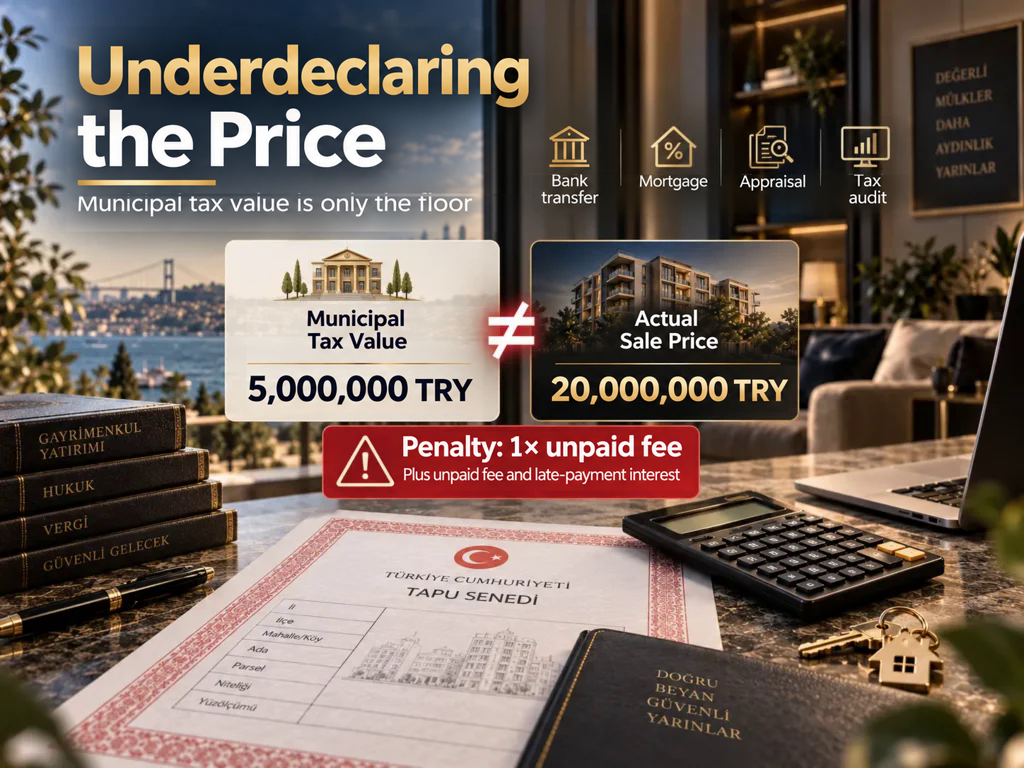
Bank payments, mortgage records and valuation reports can be considered in an examination. An appraisal above the declared amount can require an explanation, but it does not automatically replace the actual sale price or generate an instant penalty. Keep the contract and reliable payment evidence.
An understated acquisition record can also complicate a later capital-gains calculation. A private sale within five years may fall within the relevant income-tax rules, subject to statutory conditions, adjustments and exemptions. Preserve evidence of the actual acquisition cost; neither a high declaration nor a correction guarantees a particular later tax outcome.
Following an examination, notices may specify additional fees, the applicable penalty and interest for each liable party. Income-tax issues, if any, are assessed separately. Check the assessment period and available objection or settlement procedures with a qualified tax adviser.
6. Voluntary correction under Article 371
Direct answer: Voluntary disclosure may allow relief from the tax-loss penalty under Article 371 of the Tax Procedure Law, provided all statutory conditions are met. It is not unconditional amnesty.
A party who discovers an understatement should promptly seek advice and contact the competent tax office. The timing of any prior notification, examination or other statutory disqualifying event matters. Submit accurate supplementary information through an accepted official route.
Article 371 includes deadlines for completing the declaration and paying the missing tax with the required voluntary-disclosure surcharge, generally within 15 days of notification. Verify eligibility and the exact calculation before applying. A successful correction does not erase unrelated liabilities. GİB title deed fee guidance (Turkish; checked 13 November 2026).
Frequently asked questions
What is the ordinary title deed fee rate in 2026?
For an ordinary sale, the rate is 2% for the buyer and 2% for the seller, totalling 4%. Specific statutory exemptions must be verified separately.
Who pays the land registry service charge?
The buyer commonly pays it in practice. Confirm the parties’ agreement and the official transaction notice; it is separate from the percentage-based transfer fee.
Is a mortgage transaction taxed on the appraisal value?
The base is the actual declared transfer price, no lower than the municipal property-tax value. A higher appraisal or mortgage amount may prompt scrutiny, but does not automatically create a penalty.
Can an understated sale price be corrected?
Yes. An eligible voluntary correction under Article 371 can avoid the tax-loss penalty if all conditions and payment deadlines are satisfied. The missing fee and surcharge remain payable.
How are title deed fees paid?
Use the official assessment reference through authorised bank channels or the available GİB payment service. Verify the recipient and reference, and retain the receipts.
In the heart of Bağdat Avenue, Join us for a coffee
We would be pleased to welcome you to our Suadiye office to discuss your property sale, purchase or valuation goals in person.